Email: info@mambogorillasafarisuganda.com | Call: +256772666331
Top 10 Tallest Animals in the World: Amazing Giants of the Animal Kingdom

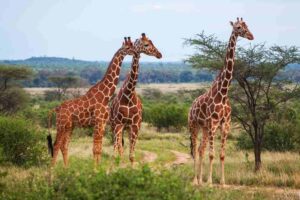
Have you ever wondered what is the tallest animal in the world?
The answer is the giraffe.
With its extraordinarily long neck and towering legs, the giraffe stands above every other living land animal. Large adult male giraffes can reach around 5.5 metres (18 feet) in height, making them one of the most spectacular animals to encounter on an African safari.
But the giraffe is not the only animal that reaches impressive heights.
From the enormous African elephant and world’s tallest bird, the ostrich, to the moose, rhinoceros and hippopotamus, the animal kingdom contains many extraordinary giants.
For wildlife lovers, Africa is particularly fascinating because some of the world’s tallest and largest terrestrial animals live on its savannahs, forests and wetlands.
In this guide, Mambo Gorilla Safaris explores the top 10 tallest animals in the world, their approximate heights, unique adaptations, habitats and where you can experience some of Africa’s most impressive wildlife on a Uganda safari.
Quick Answer: What Are the Top 10 Tallest Animals in the World?
Animal height can be measured differently depending on the species. Giraffes are normally discussed in terms of total standing height, while elephants, rhinos and hippos are commonly measured at the shoulder.
With that distinction in mind, here are ten exceptionally tall terrestrial animals:
| Animal | Approximate maximum height |
|---|---|
| Giraffe | Up to about 5.5–5.8 m |
| African elephant | Up to about 4 m at the shoulder |
| Common ostrich | Up to about 2.8 m |
| Brown bear | Up to about 2.4–3 m standing |
| Moose | Up to about 2.3 m at the shoulder |
| Dromedary camel | Around 2–2.4 m |
| Shire horse | Around 1.7–2.1 m at the shoulder |
| American bison | Around 1.8–2 m at the shoulder |
| White rhinoceros | Around 1.8–1.9 m at the shoulder |
| Hippopotamus | Around 1.5–1.7 m at the shoulder |
The exact order after the giraffe can vary depending on whether researchers compare shoulder height, total standing height, or exceptional individuals.
1. Giraffe – The Tallest Animal in the World
Scientific name: Giraffa spp.
Height: About 4.6–5.5 metres for large adult males
Habitat: African savannahs, grasslands and woodlands
The giraffe is the tallest living animal in the world.
Its incredible height comes from a combination of exceptionally long legs and a remarkably elongated neck.
A large adult giraffe can tower several metres above the ground, allowing it to browse on vegetation that many other herbivores cannot reach.
Why are giraffes so tall?
Giraffes are specially adapted for feeding high above the ground.
Their height allows them to reach:
- Acacia leaves
- Tree shoots
- High branches
- Other vegetation beyond the reach of shorter herbivores
Their long neck is particularly remarkable because, despite its extraordinary length, it contains the same number of cervical vertebrae found in most other mammals: seven.
Where can you see giraffes in Uganda?
Uganda is an excellent destination for travelers who want to see giraffes in their natural environment.
Mambo Gorilla Safaris’ wildlife itineraries include Murchison Falls National Park, where travelers can encounter giraffes during game drives. Its 10-day wildlife and primate safari specifically lists giraffes among the animals encountered in Murchison Falls.
Giraffes can also be encountered in Lake Mburo National Park, which Mambo includes in its longer wildlife and primate itineraries.
2. African Elephant – One of the Tallest and Largest Land Animals
Scientific name: Loxodonta africana
Height: Large individuals can approach 4 metres at the shoulder
Habitat: African savannahs, forests and woodlands
The African elephant is one of the most impressive land animals on Earth.
Although a giraffe is considerably taller, a large African elephant can reach around four metres at the shoulder.
Elephants are also among the heaviest terrestrial animals, making them true giants of the animal kingdom.
Their most recognizable features include:
- Large ears
- Long trunk
- Tusks
- Powerful legs
- Massive body
- Complex social behavior
African elephants in Uganda
Elephants are among the wildlife highlights of a Uganda safari.
Mambo Gorilla Safaris’ Murchison Falls itinerary specifically lists elephants among the wildlife encountered during game drives, while its Queen Elizabeth safari highlights elephants among the park’s major wildlife species.
Watching an elephant herd move across the Ugandan savannah is one of the unforgettable experiences of an African wildlife safari.
3. Common Ostrich – The Tallest Bird in the World
Scientific name: Struthio camelus
Height: Up to about 2.8 metres
Habitat: African grasslands, savannahs and semi-arid areas
The common ostrich is the tallest living bird in the world.
Unlike most large birds, ostriches cannot fly. Instead, they have developed extremely powerful legs that allow them to run rapidly across open terrain.
Their long neck and legs give them a remarkable height advantage.
Why can’t an ostrich fly?
Ostriches are simply too large and heavy for powered flight.
Instead, their evolutionary adaptations emphasize running.
Their powerful legs help them:
- Escape predators
- Travel across open landscapes
- Cover large distances
- Defend themselves when necessary
An ostrich can also use its height to look over vegetation and detect potential threats.
4. Brown Bear – An Enormous Animal When Standing
Scientific name: Ursus arctos
Standing height: Large individuals can approach 2.4–3 metres
Habitat: North America, Europe and Asia
The brown bear is another impressive giant of the animal kingdom.
Brown bears normally move on all four legs, but they can stand upright on their hind legs, making them appear exceptionally tall.
Large males are particularly impressive when standing.
Brown bears inhabit a wide variety of environments, including:
- Forests
- Mountains
- Grasslands
- Tundra
- Coastal areas
They are not African safari animals, but their remarkable standing height makes them worthy of inclusion in comparisons of the world’s tallest terrestrial animals.
5. Moose – The Tallest Member of the Deer Family
Scientific name: Alces alces
Height: Up to around 2.3 metres at the shoulder
Habitat: Northern forests and wetlands
The moose is the largest member of the deer family and one of the tallest deer species on Earth.
Its long legs help it navigate forests, wetlands and deep snow.
Male moose are particularly recognizable because of their enormous palmate antlers.
Why are moose so tall?
Their height and long legs provide several advantages.
They can:
- Move through deep snow
- Enter wetlands
- Reach vegetation
- Navigate difficult terrain
- Browse on plants at different heights
Moose are primarily found in northern regions of North America, Europe and Asia.
6. Dromedary Camel – The Tall Desert Survivor
Scientific name: Camelus dromedarius
Height: Around 2–2.4 metres depending on measurement
Habitat: Arid and semi-arid environments
The dromedary camel, also called the Arabian camel, is one of the world’s tallest domesticated mammals.
It has a single hump and is exceptionally adapted to hot, dry environments.
Contrary to a common misconception, the camel’s hump does not store water. It stores fat, which can provide an energy reserve.
Camels possess adaptations that help them survive harsh desert environments, including:
- Long legs
- Broad feet
- Efficient water conservation
- Specialized eyes
- Long eyelashes
- High tolerance for dehydration
Although dromedary camels are not native to Uganda’s wildlife ecosystems, they demonstrate how animals can evolve remarkable adaptations to their environments.
7. Shire Horse – One of the Tallest Horse Breeds
Scientific name: Equus ferus caballus
Height: Approximately 1.7–2.1 metres at the shoulder in large individuals
Habitat: Domesticated worldwide
The Shire horse is one of the tallest and most powerful horse breeds in the world.
Originally developed in England, Shire horses were historically used for heavy agricultural and industrial work.
They are known for:
- Great height
- Muscular bodies
- Powerful legs
- Feathered lower limbs
- Strong pulling ability
Unlike the wild animals on most safari lists, Shire horses demonstrate that selective breeding has also produced exceptionally tall animals.
8. American Bison – Giant of the North American Plains
Scientific name: Bison bison
Height: Around 1.8–2 metres at the shoulder
Habitat: North American grasslands and plains
The American bison is one of North America’s most recognizable large mammals.
It has a powerful body, large head, thick shoulder hump and short curved horns.
Although it is nowhere near as tall as a giraffe, its massive frame makes it one of the continent’s most impressive terrestrial mammals.
Historically, enormous bison herds moved across the Great Plains.
Today, conservation programs have helped preserve wild populations and restore the species to parts of its former range.
9. White Rhinoceros – A Giant of the African Savannah
Scientific name: Ceratotherium simum
Height: Around 1.8–1.9 metres at the shoulder
Habitat: African grasslands and savannahs
The white rhinoceros is one of Africa’s largest terrestrial mammals.
It has a massive body, thick skin, two horns and a broad mouth adapted for grazing.
Despite its name, the white rhinoceros is not actually white. The name is commonly associated with a historical interpretation of a word referring to its broad mouth.
Where can you see rhinos in Uganda?
One of the best places to experience rhino conservation in Uganda is Ziwa Rhino Sanctuary.
Mambo Gorilla Safaris incorporates rhino tracking into its Murchison Falls itineraries. Its four-day Murchison Falls and rhino safari begins with rhino tracking at Ziwa Rhino Sanctuary before continuing toward Murchison Falls National Park.
Its three-day Murchison Falls safari also includes rhino tracking at Ziwa as part of the itinerary.
This makes it possible to combine rhino conservation with a broader Uganda wildlife safari.
10. Hippopotamus – One of Africa’s Most Powerful Large Mammals
Scientific name: Hippopotamus amphibius
Height: Around 1.5–1.7 metres at the shoulder
Habitat: Rivers, lakes and wetlands in sub-Saharan Africa
The hippopotamus is not as tall as the giraffe or elephant, but its enormous body and powerful build make it one of Africa’s most impressive mammals.
Hippos spend much of their day in or near water.
They leave the water to feed, often moving onto land during the cooler parts of the day and night.
Hippos in Uganda
The Kazinga Channel in Queen Elizabeth National Park is one of Uganda’s most famous locations for observing hippos.
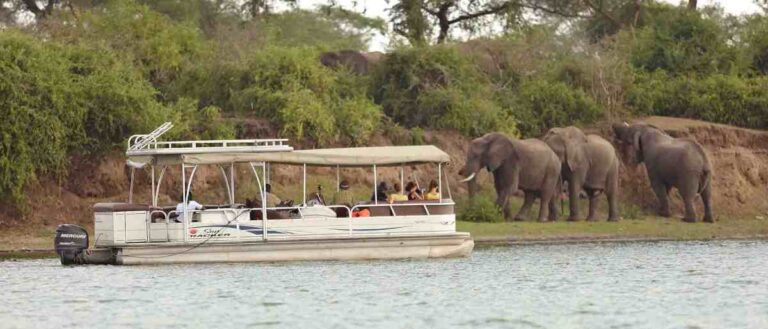
Mambo Gorilla Safaris’ Queen Elizabeth itinerary includes a boat cruise on the Kazinga Channel, where travelers can see hippos, elephants, buffaloes, crocodiles and many bird species.
This combination of water-based wildlife viewing and savannah game drives makes Queen Elizabeth an excellent addition to a Uganda safari.
Tallest Animals in Africa
Africa is home to several of the world’s most impressive tall and large terrestrial animals.
Some of the most notable include:
Giraffe
The world’s tallest living animal.
African Elephant
One of the tallest and heaviest land mammals.
Ostrich
The world’s tallest living bird.
White Rhinoceros
One of Africa’s largest grazing mammals.
Hippopotamus
A huge semi-aquatic mammal found in Uganda’s lakes and rivers.
These animals make Africa a particularly fascinating continent for wildlife enthusiasts.
Why Are Giraffes So Tall?
Giraffes have evolved their remarkable height over millions of years.
Their long legs and neck allow them to access food high in trees.
This reduces competition with shorter herbivores feeding closer to the ground.
Their height may also provide an advantage when scanning the surrounding landscape.
But being extremely tall presents physiological challenges.
A giraffe’s heart must pump blood high enough to reach its brain, several metres above ground level. The species therefore has specialized cardiovascular adaptations that help regulate blood flow and blood pressure.
This makes the giraffe one of the most fascinating examples of adaptation in the animal kingdom.
What Is the Tallest Animal in the World?
The giraffe is the tallest living animal in the world.
A large adult male can reach approximately 5.5 metres in height, making it significantly taller than an African elephant.
Its long neck and legs are responsible for its extraordinary stature.
What Is the Tallest Land Animal?
The giraffe is the tallest living land animal.
Its extraordinary height allows it to browse vegetation high above the ground and gives it a unique perspective over the African savannah.
What Is the Tallest Bird in the World?
The common ostrich is the tallest living bird.
It can reach approximately 2.8 metres.
Although it cannot fly, its powerful legs allow it to run quickly across open African landscapes.
Where Can You See Tall Animals in Uganda?
Uganda offers several opportunities to encounter some of Africa’s most impressive large animals.
Murchison Falls National Park
Murchison Falls is one of the most important wildlife destinations in Uganda.
Mambo Gorilla Safaris’ published itinerary highlights game drives where travelers can see giraffes, elephants, lions, buffaloes, antelopes and other wildlife, followed by a Nile boat cruise where visitors can see hippos and crocodiles.
This makes Murchison Falls an excellent destination for travelers interested in large African mammals.
Queen Elizabeth National Park
Queen Elizabeth National Park offers an exceptionally diverse wildlife experience.
Mambo’s Queen Elizabeth itinerary highlights:
- Elephants
- Buffaloes
- Lions
- Leopards
- Hippos
- Nile crocodiles
- Warthogs
- Antelopes
- Tree-climbing lions
The park also offers game drives and Kazinga Channel boat cruises.
Lake Mburo National Park
Lake Mburo provides another opportunity to encounter large African wildlife.
Mambo’s 10-day wildlife and primate itinerary includes Lake Mburo and notes wildlife such as giraffes, zebras, elands, buffaloes, waterbucks, antelopes, hippos and warthogs.
The park can therefore be an excellent addition to a longer Uganda safari.
Ziwa Rhino Sanctuary
If rhinos are high on your wildlife wish list, Ziwa Rhino Sanctuary offers an opportunity to experience rhino conservation and guided tracking.
Mambo Gorilla Safaris incorporates Ziwa Rhino Sanctuary into its Murchison Falls safari itineraries, making it possible to combine rhino tracking with a traditional Uganda wildlife safari.
Combine Uganda Wildlife With Gorilla Trekking
One of the greatest advantages of a Uganda safari is that travelers do not have to choose between savannah wildlife and primate experiences.
You can combine:
Murchison Falls → giraffes, elephants, lions and other savannah wildlife
Queen Elizabeth → elephants, buffaloes, hippos, lions and tree-climbing lions
Kibale → chimpanzee trekking and other primates
Bwindi → mountain gorilla trekking
Mambo Gorilla Safaris’ 10-day wildlife and primate itinerary combines Murchison Falls, Kibale Forest, Queen Elizabeth, Bwindi and Lake Mburo, incorporating game drives, boat cruises, chimpanzee trekking and gorilla trekking.
This creates a diverse Uganda safari rather than a single-destination wildlife trip.
Tall Animals vs Biggest Animals: What’s the Difference?
The terms tallest and biggest do not mean the same thing.
An animal can be:
- Tallest
- Heaviest
- Longest
- Largest by body volume
- Largest at the shoulder
For example:
Giraffe: tallest living animal
African elephant: among the heaviest land animals
Ostrich: tallest living bird
Moose: tallest member of the deer family
White rhinoceros: one of Africa’s largest land mammals
Hippopotamus: extremely massive despite having a much lower shoulder height than a giraffe
Therefore, a list of the biggest animals in the world would be different from a list of the tallest animals in the world.
Why Do Some Animals Become So Tall?
Height can provide several advantages in the natural world.
1. Access to food
Giraffes can reach leaves high in trees.
2. Better visibility
Tall animals can see over vegetation and across open landscapes.
3. Movement through difficult environments
Long legs can help certain species move through snow, wetlands or dense vegetation.
4. Competition
Body size can influence competition between individuals of the same species.
5. Survival and adaptation
Height is one of many characteristics that evolve in response to environmental pressures.
However, being large also requires enormous amounts of energy and specialized physiological systems.
How to Photograph Tall Animals on a Uganda Safari
Tall animals make fantastic safari photography subjects.
Here are some tips for photographing them.
Photograph giraffes against the sky
A sunrise or sunset can emphasize the giraffe’s extraordinary height.
Include the landscape
A wide-angle photograph can show how tall a giraffe or elephant is relative to the surrounding environment.
Photograph elephants from a safe distance
Never ask a guide to drive dangerously close to wildlife for a photograph.
Use a longer lens
A telephoto lens allows you to capture wildlife without approaching too closely.
Be patient
Wildlife photography is about waiting for natural behavior rather than forcing an encounter.